


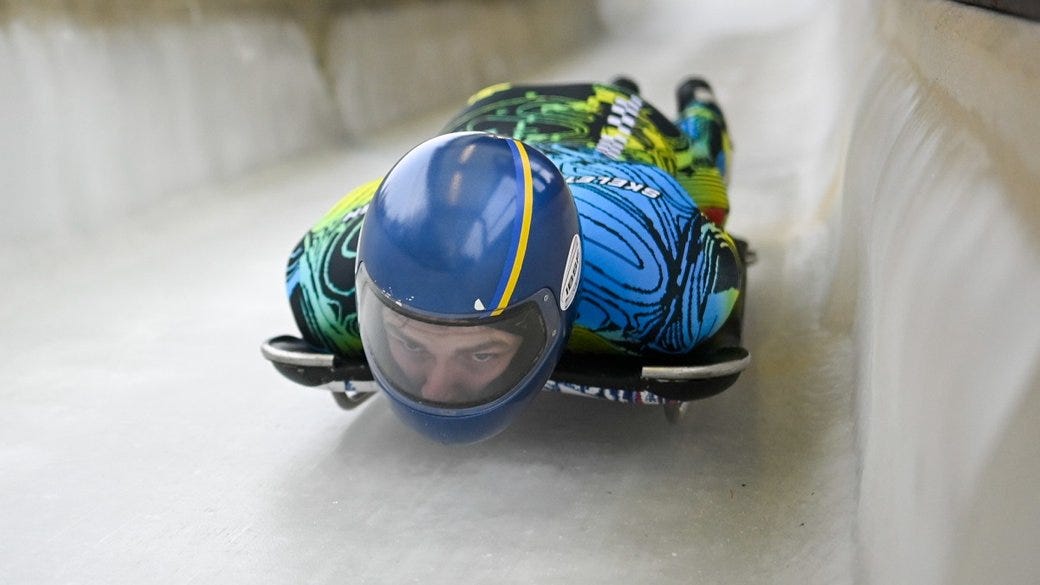
The International Bobsleigh and Skeleton Federation (IBSF) has ordered Ukraine’s junior skeleton team to remove “Free Azov” messages from its competition equipment, arguing that the slogan violates the organization’s commitment to political neutrality.
The dispute emerged on Nov. 27, after Ukrainian skeleton racer Vladyslav Heraskevych revealed that the federation had sent a letter demanding the immediate removal of the messages. The stickers were placed on the athletes’ sleds on Nov. 18, at their own initiative, to draw attention to Ukrainian prisoners of war held by Russia.
The demand was delivered on Nov. 26, one day before the junior team was scheduled to begin its international season at a European Cup event in Lillehammer, Norway.
The IBSF’s position is that the slogan refers to a specific military unit involved in an ongoing armed conflict. The organization told German news agency dpa that the wording could not be permitted during training or competition runs.
IBSF President Heike Grösswang defended the decision by pointing to the federation’s obligation to remain politically neutral.
“As an international sports federation, we are committed to political neutrality under our statutes,” Grösswang told dpa. She added that she wanted athletes’ sporting performances to remain the focus of attention at IBSF events.
Heraskevych, however, questioned the decision, particularly because the federation had acknowledged the humanitarian purpose behind the message.
“Today, to our great surprise, we received a letter from the head of the International Bobsleigh and Skeleton Federation demanding that these slogans be immediately removed from our competition equipment,” Heraskevych said in a statement on social media.
“What surprises me the most is that the same letter acknowledges the humanitarian mission behind the slogan, but then goes on to talk about war and politics.”
The All-Ukrainian Bobsleigh and Skeleton Federation has since submitted a formal response arguing that the messages are permissible under IBSF regulations. The Ukrainian side is seeking to have the decision overturned.
The humanitarian campaign behind the slogan
The “Free Azov” message is connected to Ukrainian service members captured during the defense of Mariupol, particularly those who fought at the Azovstal steelworks during the early stages of Russia’s full-scale invasion.
After weeks of fighting and a prolonged Russian siege, approximately 2,500 Ukrainian defenders left the Azovstal plant in May 2022 and entered Russian captivity under orders from Ukraine’s military leadership. Many have remained imprisoned.
The International Committee of the Red Cross (ICRC) confirmed in May 2022 that it had registered hundreds of Ukrainian prisoners of war leaving the plant. The organization explained that registration was intended to help track captured personnel and maintain contact with their families.
Their treatment in captivity has also been a significant international human rights concern. In an October 2024 report, the United Nations Human Rights Monitoring Mission in Ukraine documented widespread and systematic torture and ill-treatment of Ukrainian prisoners held by Russia.
Of the 174 recently released Ukrainian prisoners interviewed by the mission over an 18-month period, 169 provided detailed accounts of torture or severe mistreatment. The reported abuses included beatings, electric shocks, suffocation, sleep deprivation and mock executions. The mission also documented 10 deaths among Ukrainian prisoners due to torture, poor conditions or inadequate medical care.
The slogan has become a recognizable part of Ukrainian athletes’ efforts to keep the prisoners’ situation in the international spotlight.
Ukrainian heavyweight boxer Oleksandr Usyk displayed a flag reading “Free Azovstal Defenders” ahead of his December 2024 rematch against Tyson Fury. He used the message again before an open training session ahead of his 2025 fight against Daniel Dubois.
Ukraine’s national soccer team has also displayed similar messages, while supporters have carried banners calling for the release of the captured defenders.
Heraskevych cited those examples when questioning why the slogan had become an issue for the junior skeleton team.
“Somehow, the inscription on the sleds of our juniors became a problem for the International Bobsleigh and Skeleton Federation,” he said.
Another confrontation over Ukrainian athletes’ expression
The latest dispute is not the first time Heraskevych has clashed with international sports authorities over messages connected to the war.
At the 2026 Winter Olympics in Milan-Cortina, the Ukrainian skeleton racer was disqualified after refusing to replace a helmet featuring images of Ukrainian athletes killed during Russia’s invasion.
The International Olympic Committee (IOC) determined that the helmet violated its athlete expression guidelines, which restrict demonstrations and political messaging on the field of play. The organization offered alternatives, including a black armband, but Heraskevych refused to compete without the helmet.
He appealed the decision to the Court of Arbitration for Sport (CAS), which rejected his application on Feb. 13.
The court expressed sympathy for Heraskevych’s commemoration but upheld the restrictions, finding that the IOC’s guidelines provided a reasonable balance between athletes’ freedom of expression and the interests of keeping competition focused on sport.
The Olympic case is separate from the current dispute. The earlier decision concerned the IOC’s rules for the Olympic Games, while the latest restriction involves the IBSF’s regulations at its own international competitions.
Nevertheless, both incidents raise questions about how sporting organizations distinguish between political demonstrations and messages intended to commemorate victims or draw attention to humanitarian issues.
The limits of political neutrality in sport
The IBSF’s argument centers on its responsibility to maintain political neutrality at international events. From the federation’s perspective, allowing references to a specific military unit involved in an active conflict could conflict with that obligation.
However, the Ukrainian federation’s response highlights a different interpretation of the message, arguing that its purpose is humanitarian rather than political.
That distinction is at the heart of the disagreement. The slogan calls for the release of prisoners of war, but its reference to Azov also connects it to a military formation involved in the conflict. The two aspects are difficult to separate entirely, which helps explain why the federation and the Ukrainian side have reached different conclusions.
The controversy also raises questions about consistency. Similar appeals have appeared in boxing and soccer without the same reported restrictions, although the rules and circumstances governing those events may differ.
For the IBSF, the issue is not simply whether athletes should be allowed to express themselves. It is whether a message referencing a military unit in an ongoing conflict can be displayed on equipment during an international sporting event without compromising the organization’s neutrality rules.
The Ukrainian federation is challenging that interpretation, and the outcome could have implications for how humanitarian messaging is treated at future competitions.
For the junior athletes, the dispute comes at the beginning of an important international season. Their European Cup appearance in Lillehammer is part of their preparation for the 2028 Winter Youth Olympic Games.
The disagreement leaves a broader question for international sport: when does a humanitarian appeal become a political statement, and who should have the authority to make that distinction?