


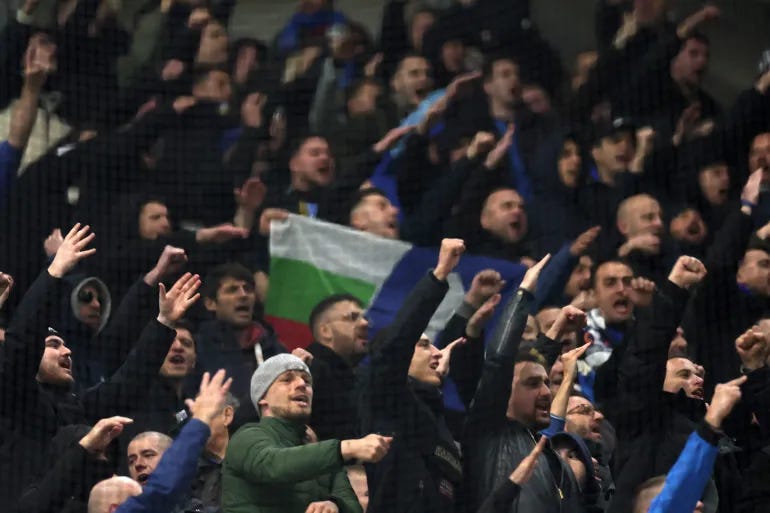
Football grounds have traditionally been arenas for political expression. Whether it be in the form of nationalism or structured anti-fascist action, supporters’ culture has often mirrored wider political debate.
Thursday’s Europa League game between Olympique de Marseille and Levski Sofia was once again an example of this. A video clip apparently showed a Levski supporter making a Nazi salute and then fighting ensued between the two sets of supporters. This led to criminal inquiries in France, a UEFA disciplinary inquiry and reprimands from politicians in both countries.
Whilst most attention has been drawn to the actual fighting, the display of Nazi imagery prompts further discussion regarding the extent to which far-right ideology continues to influence football. Moreover, it raises issues relating to the effectiveness of football clubs and institutions in tackling such ideologies.
Football and far-right politics
There is nothing novel about links between football and far-right politics. Historically, in parts of Europe, supporter cultures have been affiliated with nationalist, racist and neo-Nazi politics.
In some instances, ‘ultras’, in addition to supporting particular football teams, have adopted their own political agenda. These have included political protest, espousing nationalist views and clashing with opposing supporters. Football supporter culture has thus at times acted as a medium for extremists to further their cause.
Nevertheless, football supporter culture is not solely influenced by far-right politics. Anti-fascist and anti-racist supporter groups are also active in Europe and at times actively challenge far-right influence.
Indeed, this was seen in Marseille. In reaction to the Nazi salute, supporters reportedly chanted an anti-fascist slogan. Again, this demonstrates how different political influences can exist in one sporting context.
Whilst it is crucial to recognise that not all members of a football supporters’ group will act in the same way, current inquiries have failed to confirm that the reported Nazi salute was linked to a structured extremist network. Nonetheless, the fact that such imagery was displayed at an international game emphasises that extremist symbols continue to feature in football.
What further action can be taken?
UEFA and national footballing associations consistently emphasise their commitment to tackling racism and discrimination. Clubs can be fined, or even have their grounds closed, for discriminatory behaviour by supporters – under UEFA’s disciplinary code.
However, retrospective action does not always resolve underlying issues.
Following the Marseille game, French prosecutors launched independent criminal inquiries into alleged severe disorder amongst Marseille supporters, as well as alleged hate speech linked to the Nazi salutes. UEFA additionally sent in disciplinary observers to investigate.
Whilst these inquiries could reveal personal culpability and assess whether UEFA’s code has been breached, they will not necessarily clarify how extremist ideology is embedded into supporter culture.
Although a club can be held to account for the behaviour of its supporters (for instance via fines or closure of its ground), football institutions lack the power to autonomously disrupt political networks. Nor can they entirely prevent extremist groups from using football as a medium for furthering their cause.
Whilst football institutions can and should reprimand inappropriate behaviour, they must also seek improved methods for recognising and challenging structured discriminatory action.
Football and politics are inextricably linked
The actions of both the French and Bulgarian governments illustrated how rapidly a football stadium incident can escalate into a national political issue.
French President Emmanuel Macron denounced the football-related violence and exchanged discussions with Bulgarian Prime Minister Rumen Radev. Bulgarian officials also demanded a detailed investigation be undertaken.
This further illustrates an inherent paradox in contemporary football. Although football institutions commonly assert that the sport has the power to unite people across national and cultural divides, it is more difficult to uphold this view when football grounds are used to disseminate extremist ideology and to intimidate.
While it is essential that football supporters are not automatically labelled as extremists merely for holding political views or engaging in political protest, Nazi imagery is unquestionably linked to an extremist ideology which promotes racial superiority, anti-semitism and even genocide.
Whilst the outcome of the criminal and UEFA disciplinary inquiries into the Marseille situation will contribute to assessments of what occurred, the fundamental issue will persist irrespective of these conclusions.
Whilst football cannot exclude all political trends from its stadiums, it can choose how vigorously it challenges those which attempt to use the sport for disseminating messages of hatred.